
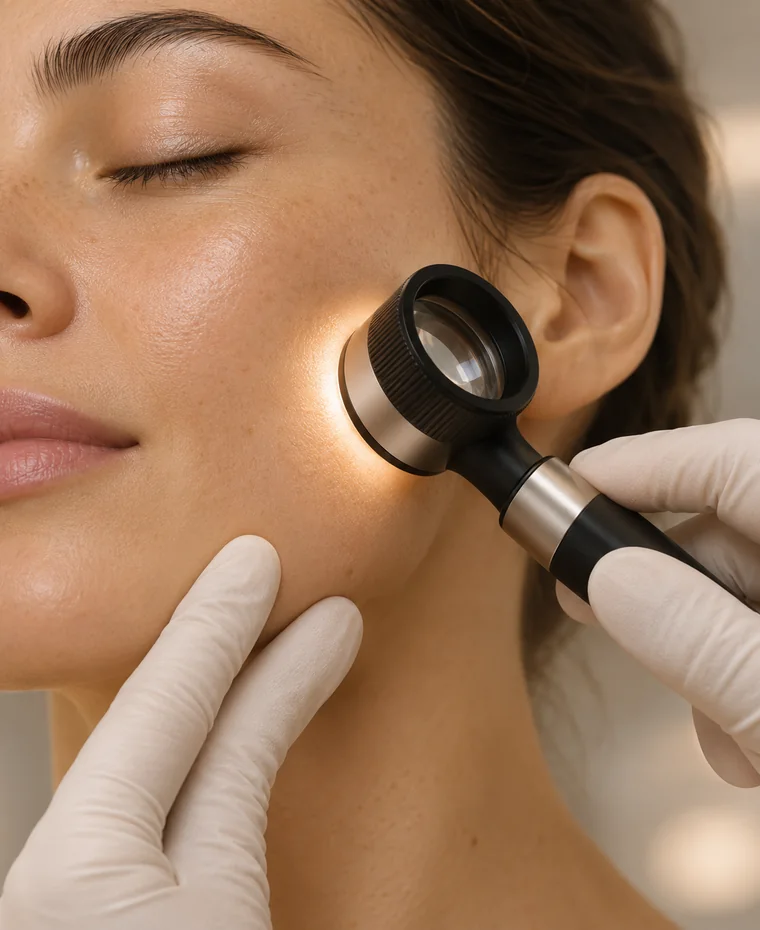
At a glance: Dermatology covers medical diagnosis, skin cancer, hair and nail disease, and procedural or cosmetic care. Check the physician's legal authorization, dermatology specialty qualification, and experience with your particular concern—not just the name of a beauty treatment.
A dermatologist's training matters because skin conditions overlap
A changing mole, stubborn rash, acne, hair loss, pigmentation, a scar, and a request for laser resurfacing may all lead someone to a dermatology practice. Yet the underlying clinical questions are not interchangeable. A skin complaint that looks cosmetic can have a medical cause, and a visibly minor lesion can sometimes require examination or pathology. A good dermatologist considers diagnosis, alternatives, and whether a procedure is necessary before selling a treatment package.
A physician who advertises injectables or aesthetic procedures is not necessarily a physician with formal dermatology specialty training. Nonphysician skin-care professionals play legitimate roles within the boundaries of their training and local laws, but their qualifications should not be presented as equivalent to those of a medical dermatologist. Ask who performs the clinical assessment and who is responsible for prescribing, biopsying, treating complications, or making a referral.
The most useful way to evaluate a practitioner is to start with the clinical problem. Medical dermatology, pediatric dermatology, dermatologic surgery, Mohs surgery, and cosmetic dermatology can demand different experience. A clinician may be excellent with routine acne care but not the best person for a complex skin cancer or difficult procedural complication. Matching qualifications to the problem is more informative than collecting impressive-sounding designations.
U.S. dermatology board certification and licensing
In the United States, a physician's state medical license is distinct from specialty certification. The American Board of Dermatology, an ABMS member board, provides a public search for its diplomates. The American Academy of Dermatology also offers patient guidance about evaluating dermatologists. A membership acronym can be helpful context, but it is not an excuse to skip checking actual board and license records.
Use ABMS Certification Matters as a patient-oriented cross-specialty tool, then check FSMB DocInfo or the relevant state board for the physician's license and public information. A clinician may have a medical license and experience in aesthetic medicine without being board certified in dermatology. That distinction should be clearly explained in any listing or consultation. Do not confuse a short cosmetic course certificate with a formal residency and board credential.
For skin cancer care, ask which clinicians evaluate suspicious lesions, interpret pathology, and perform definitive surgery if needed. If Mohs surgery is proposed, inquire about training in that procedure and the facility's pathology workflow. For complex reconstruction after excision, the team may involve several specialists. The relevant credential is not simply “skin expert” but documented qualifications for the exact work being done.
Evaluating dermatology credentials in Colombia
In Colombia, verify the physician's professional standing through the official ReTHUS information and consultation system. Ask for the exact specialist qualification and university or credentialing institution. ReTHUS relates to Colombian professional authorization; it does not confer U.S. ABMS certification. If a practice uses the English phrase “board certified,” ask what issuer and jurisdiction it actually means.
Clinic authorization should be researched separately when relevant, using the REPS provider registry. This matters particularly for procedures requiring particular equipment, monitoring, sterile technique, pathology handling, or surgical services. Ask where the service will occur rather than assuming that every location within a clinic brand offers identical authorized services.
International patients may have additional needs: English-speaking consultations, written skin-care instructions, access to follow-up photography, prescription arrangements, and a pathway for biopsy results or complications after returning home. Confirm whether the same physician will evaluate you remotely and in person. Some conditions need a physical examination or tissue sampling and cannot be diagnosed responsibly from photographs alone.
Match the specialist to the reason for your visit
Acne, rosacea, and inflammatory skin disorders
When acne is persistent or scarring, or when rosacea, psoriasis, eczema, or another chronic inflammatory condition is suspected, ask how the clinician establishes the diagnosis and monitors treatment. A medically grounded consultation includes the possibility of prescription medicines, side effects, pregnancy considerations where relevant, and the need for a follow-up plan. A cosmetic package may improve appearance without addressing the underlying disease.
Skin lesions and cancer evaluation
A new, changing, bleeding, or otherwise concerning lesion deserves a medical assessment rather than a promise of simple cosmetic removal. Ask when dermoscopy, biopsy, histopathology, or referral is appropriate. If a lesion is removed, learn who interprets the pathology and how results will be communicated. Cosmetic removal without clear follow-up can leave a patient uncertain about whether a lesion was medically evaluated.
Lasers, peels, injectables, and pigmentation
Energy-based devices and injectable treatments carry technique-dependent risks, including burns, pigment changes, vascular complications, and infection. Ask who performs the treatment, what training applies, whether the device is appropriately maintained, and what happens if the result is not as expected. For darker skin tones or conditions prone to post-inflammatory hyperpigmentation, discuss why a particular modality is suitable. Promises of zero downtime or no side effects should be treated skeptically.
Hair and scalp concerns
Hair loss may involve hormones, inflammation, scarring, nutrition, medication effects, or other causes. Before a hair transplant or expensive product plan, ask whether the scalp has been examined for treatable disease and what differential diagnoses have been considered. A dermatologist can be part of a broader care pathway, while the qualifications required for surgical hair transplantation must also be reviewed separately.
The consultation: what excellent communication looks like
A useful consultation should leave you with a working explanation of the diagnosis, the reasonable options, what each option can and cannot do, the expected timeline, and what would prompt reassessment. Ask how success will be measured and whether the recommended treatment has to continue indefinitely. For elective procedures, ask what evidence supports a claimed benefit and what alternatives exist at lower cost or risk.
If a clinician requests photographs, clarify how images are stored, who can access them, and whether they may be used in promotion. Sensitive face or body images should not automatically become marketing material. Consent to treatment is different from consent to advertise a before-and-after photograph. A reputable practice should be able to explain both processes separately.
Routine dermatology is often longitudinal. Continuity can matter more than the number of devices a clinic advertises. If traveling internationally, ask what happens when a prescription needs adjustment or a skin condition flares after you return home. For chronic problems, consider whether local ongoing follow-up may be better than a one-time visit abroad.
Questions to ask before booking
- Are you licensed to practice medicine where I will receive care?
- What formal dermatology specialty training do you have, and how can it be verified?
- Will you personally conduct the diagnostic examination?
- Does my concern require a biopsy, lab evaluation, or referral rather than a cosmetic procedure?
- What are the alternatives, including observation or medical treatment?
- Who operates the proposed laser or performs the injection or excision?
- What complications can occur, especially for my skin type and medical history?
- How are pathology results, prescriptions, and follow-up visits handled?
- Is the clinic or service registered or authorized where required?
- Will my clinical photos be used only for care unless I separately authorize another use?
Red flags and common misunderstandings
“Dermatologist,” “aesthetic physician,” “skin specialist,” and “licensed aesthetician” can represent different roles depending on country and professional regulation. Do not assume all titles indicate completion of a recognized dermatology residency. Equally, not every dermatology visit needs a complex procedure. Be wary if a clinic proposes aggressive treatment for every inquiry, refuses to discuss diagnosis, or discourages a biopsy for a changing lesion without a clinical explanation.
Beware of online rankings built entirely from paid placement, testimonials with no independent context, and claims that a device eliminates all risks. A clean clinic photo does not establish authorization. If a physician's details cannot be matched in an official registry, ask about spelling, registration timing, and alternative proof instead of immediately concluding either that they are qualified or that they are not.
What to compare in a dermatology quote
For routine appointments, distinguish a consultation fee from laboratory tests, prescription medicines, biopsy, pathology, and follow-up. For elective treatments, identify the number of sessions, expected downtime, medication aftercare, and policies for complications or incomplete response. A low advertised per-session rate may not reflect the expected total course, while a high rate does not itself prove specialist qualifications.
Before traveling for cosmetic dermatology, obtain a plan for sun exposure, aftercare, and returning to work. Some procedures require avoiding travel or particular activities for a period determined by your clinician. Ask whether urgent assessment is available after the treatment. If you need care in English, confirm that the clinician—not only the sales team—can explain risks and consent in a language you understand.
Frequently asked questions
Is a cosmetic skin clinic the same as a dermatology practice?
No. Clinics can employ different professionals and offer different services. The existence of a skin-care menu does not prove that a board-certified or formally trained dermatologist will diagnose or treat you. Ask who the treating clinician is and what credentials apply to the work proposed.
Does FAAD mean board certification?
The American Academy of Dermatology explains that FAAD identifies a Fellow of the Academy and indicates board-certified dermatologist status within its context. Still, check the individual physician and the board information directly rather than relying on letters alone. A credential should always correspond to a specific person and be accurately represented.
Should a dermatologist remove a mole without testing it?
The answer depends on clinical evaluation; not every benign lesion requires pathology and some require further assessment. Ask why a lesion is or is not being sampled, how the diagnosis was reached, and how you will receive results if tissue is sent to pathology. If you have a changing or worrying lesion, an online image is not a substitute for an appropriate examination.
Can I receive an accurate diagnosis from a virtual consultation?
Teledermatology can be useful for triage and follow-up, but not all skin conditions can be assessed definitively remotely. Image quality, lesion location, required tests, and clinical context matter. A responsible clinician should tell you when an in-person examination or biopsy is needed.
Is ReTHUS the Colombian equivalent of ABMS board certification?
No. ReTHUS concerns professional registration and authorized practice in Colombia. ABMS board certification concerns U.S. specialty boards. They answer different questions. When researching a Colombian dermatologist, use official Colombian sources and confirm the actual specialty qualification rather than translating one system into the other.
Researching care?
Compare qualifications before you commit.
Check the official sources yourself, then request an introduction if you would like help identifying a specialist to consult.
Request a dermatology consultation →